
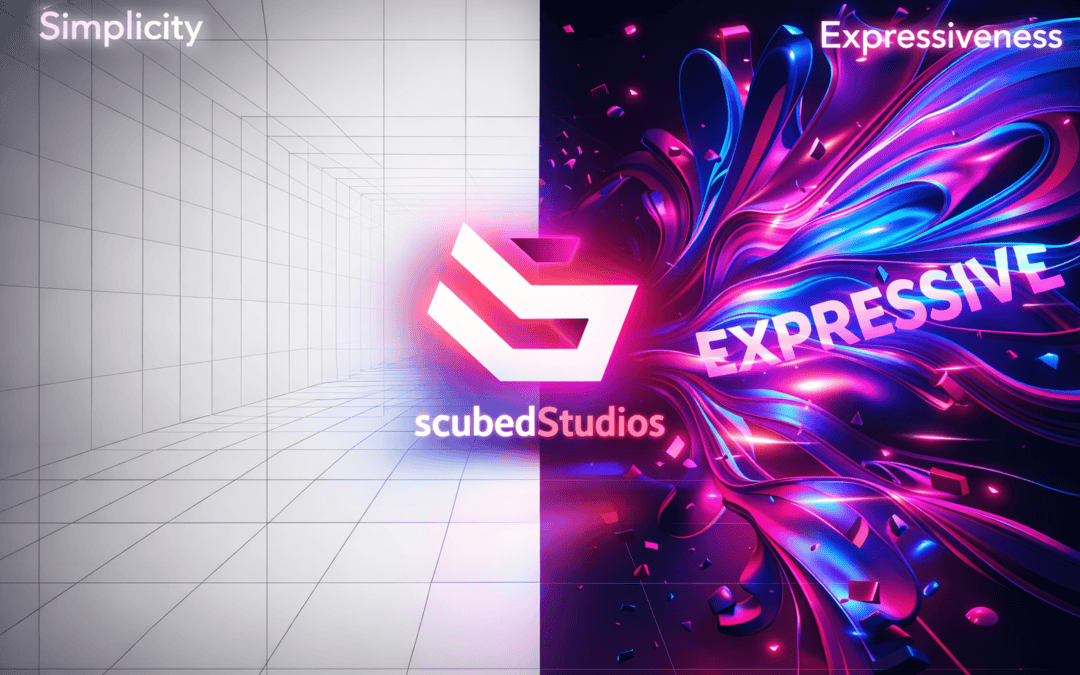
The Evolution of Web Design in 2026: Where Simplicity Meets Brand Expression
Web design has always evolved in cycles, but the changes shaping 2026 feel less like a passing trend and more like a natural convergence of best practices. After years of minimalism, brutalism, and maximalist experimentation, modern web design has found a balance where simplicity and brand expression work together.
Today's websites are cleaner, faster, and more accessible than ever before. At the same time, they deliver stronger storytelling, emotional engagement, and distinctive brand identities. With more than 15 years of experience in UX, UI, and product strategy, I've witnessed the transition from skeuomorphic interfaces and flat design to highly personalised, system-driven digital experiences. In 2026, great web design is no longer just about aesthetics—it requires clarity, consistency, and character at every touchpoint.
Moving Beyond Generic Minimalism
In the early 2020s, many websites looked remarkably similar. Large hero images, centred headlines, rounded cards, soft gradients, and minimalist layouts became the default design language across industries. While these websites appeared polished and professional, they often lacked uniqueness.
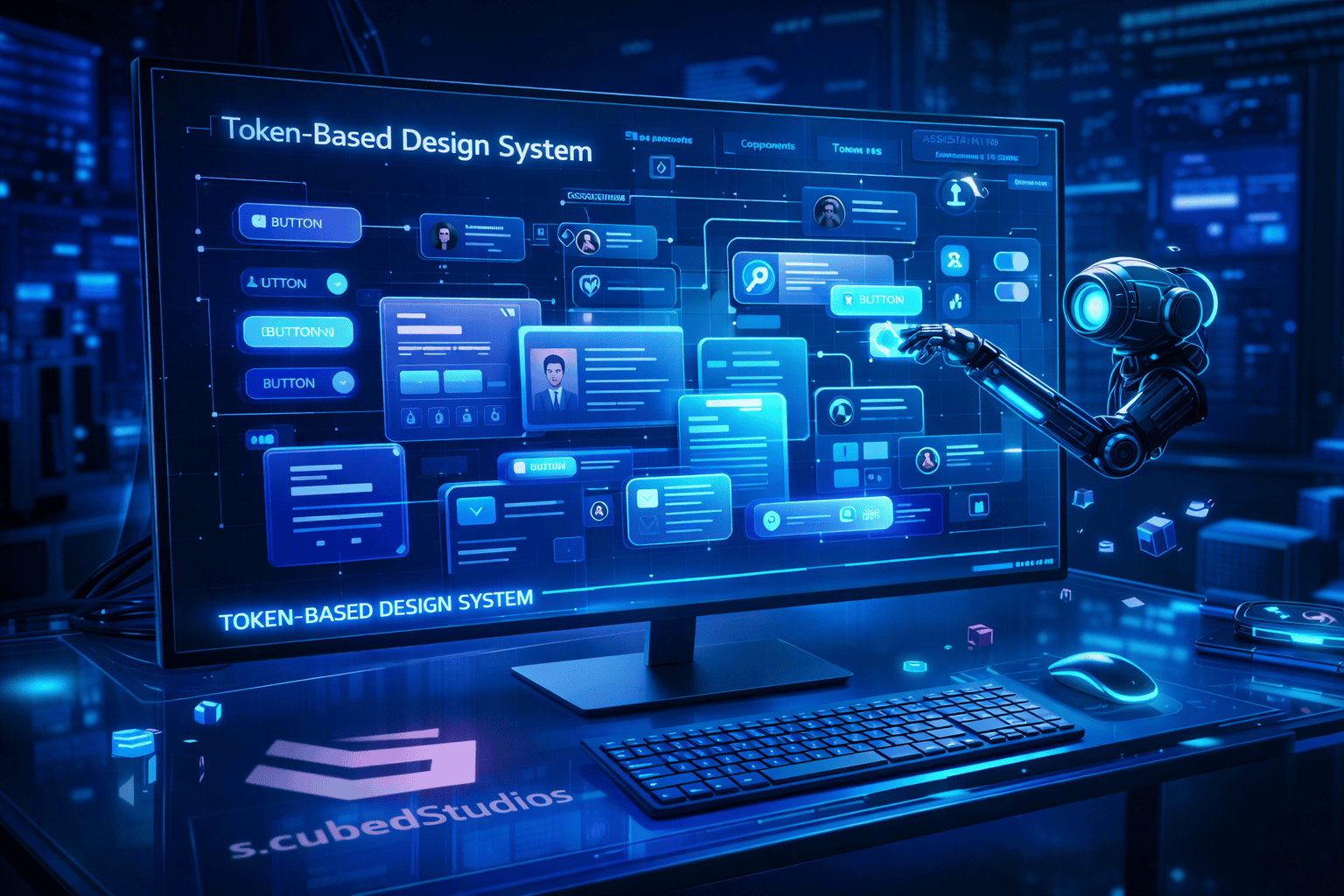
Futuristic token-based design workspace
As competition increased and customer acquisition costs rose, businesses realised that attractive but generic websites were no longer enough. Brands needed to stand out.
Today, simplicity remains a core principle of modern web design. Fast-loading pages, intuitive navigation, and clear visual hierarchies continue to improve user experience. However, businesses are now pairing simplicity with stronger visual identities.
Key trends include:
- Custom typography and variable fonts
- Purpose-driven colour systems
- Unique illustrations and visual assets
- Subtle 3D elements and textures
- Stronger brand storytelling throughout the user journey
The result is a web experience that feels both intuitive and memorable.
Component-Driven Design and Design Systems 2.0
Design systems have evolved from industry buzzwords into essential business assets. In 2026, token-based design systems help organisations maintain consistency across websites, mobile apps, digital products, kiosks, and other customer-facing platforms.
These systems define:
- Colours
- Typography
- Spacing
- Border radius values
- Shadows
- Motion behaviours
AI-powered theming tools now assist teams in generating on-brand variations for campaigns, regional markets, and seasonal promotions. While the design system handles consistency across 80–90% of components, designers focus on storytelling, layout composition, and user engagement.
This approach allows organisations to scale efficiently while preserving a distinctive brand identity.
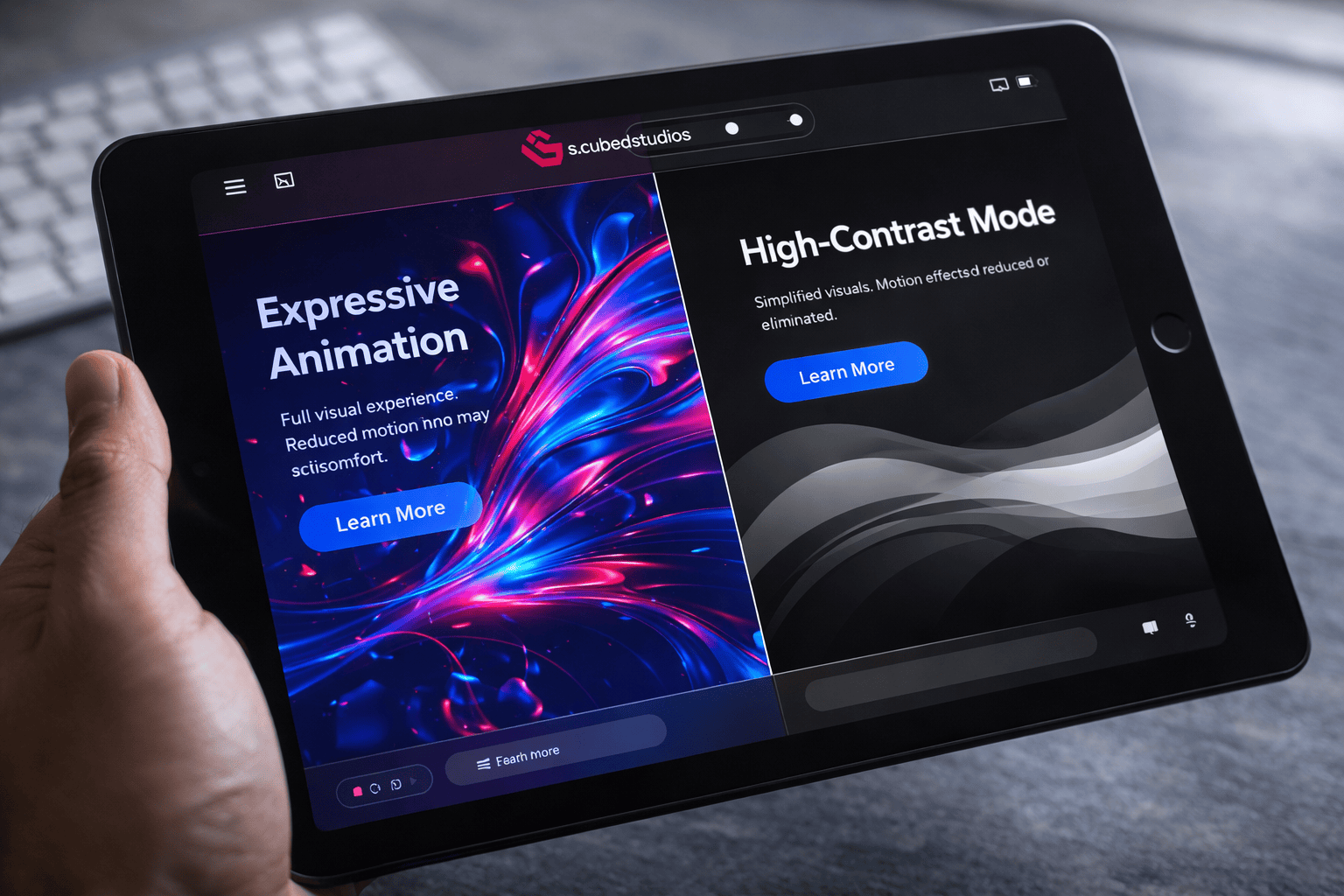
Tablet showing expressive vs high-contrast modes
Performance, Accessibility, and Core Web Vitals Are Now Standard
Website performance and accessibility are no longer optional. They have become fundamental requirements for successful digital products.
Google's Core Web Vitals continue to influence design and development decisions from the beginning of every project. Key performance metrics include:
- Largest Contentful Paint (LCP)
- Cumulative Layout Shift (CLS)
- Interaction to Next Paint (INP)
Rather than treating performance optimisation as a final-stage task, teams now incorporate these requirements during planning, design, and development.
Accessibility has also evolved beyond compliance. Leading organisations view accessibility as a strategic KPI that improves usability for all users.
Modern websites increasingly support:
- Reduced-motion preferences
- High-contrast viewing modes
- Optimised dark and light themes
- Screen reader compatibility
- Voice navigation
- Low-bandwidth experiences
Designers are building for diverse audiences, devices, and cognitive needs rather than focusing solely on premium hardware.
Motion Design with Purpose
Between 2022 and 2026, motion design matured into a strategic UX tool.
The era of excessive parallax effects and distracting animations has largely ended. Instead, motion is now used to improve usability and guide users through digital experiences.
Effective motion design helps:
- Direct user attention
- Clarify page transitions
- Provide interactive feedback
- Reinforce brand personality
- Improve perceived usability
Many brands now develop unique motion signatures that include specific easing curves, timing patterns, and animation behaviours. These subtle details help create a cohesive brand experience without sacrificing performance.
Importantly, reduced-motion preferences are respected by default, ensuring accessibility remains a priority.
Personalisation and Adaptive User Experiences
Personalisation in 2026 has become more transparent and user-focused.
Modern websites use adaptive content blocks that respond to factors such as:
- User behaviour
- Geographic location
- Customer role
- Previous interactions
Users can also customise their experiences through persistent preference settings, including:
- Font size
- Contrast levels
- Interface density
- Content formats
Artificial intelligence plays an increasingly important role in personalisation, but transparency remains critical. Users expect clear explanations for recommendations and easy access to controls that allow them to modify or disable personalised experiences.

Neon cursor trail and logo design
The Rise of Multimodal and Voice-Integrated Interfaces
The web is no longer limited to traditional screen interactions.
Voice search, conversational interfaces, and multimodal experiences are becoming standard components of modern digital products.
Today's websites increasingly support:
- Voice-enabled navigation
- Voice-powered search
- Conversational assistants
- AI-driven onboarding experiences
- Augmented reality product visualisation
- Virtual reality experiences with accessible fallbacks
Design teams now consider how users interact through speech, chat, touch, and traditional navigation methods. Content must be flexible enough to work across multiple interaction models while maintaining consistency and usability.
Ethical and Trust-Centred Design
Years of dark patterns, misleading interfaces, and opaque data practices have increased consumer demand for transparency.
As a result, ethical design has become a major focus in 2026.
Leading organisations prioritise:
- Clear privacy communication
- Transparent data collection policies
- Honest subscription processes
- Simple cancellation workflows
- Verified customer reviews
- Clear sponsorship disclosures
Trust-centred UX not only improves user confidence but also contributes to higher conversion rates, stronger customer relationships, and greater long-term loyalty.
Conclusion
The future of web design is built on balance.
The most successful websites combine simplicity in structure with expressiveness in execution. They deliver fast, accessible, and reliable experiences while maintaining a distinctive brand identity that resonates with users.
As digital experiences continue to evolve, organisations that successfully integrate performance, accessibility, storytelling, personalisation, and ethical design into cohesive systems will be best positioned to lead the next generation of web innovation.
In 2026, great web design is no longer about choosing between simplicity and creativity—it is about mastering both.
Recent Comments